Recording
At the start of writing this I am listening to Edgard Varese’s Déserts. I am up to the first mindbending interpolation of the tape track – at this juncture it is as if the whole work turns sideways or leaps into another dimension, a dimension that seems flattened out to us now with the distance of time (and poor/decayed state of the original tape).
There are other near contemporaneous works with electronics and live-acoustic instruments, and certainly several of these have had an impact on me – without being exhaustive: Roberto Gerhard’s Symphony No. 3 “Collages” which, premiered in 1960, is one of the early works where tape and orchestra are simultaneous, and the contemporaneous Kraanerg by Iannis Xenakis and Per Bastiana by Luigi Nono. Gerhard’s work opens in an astonishing fasion with the orchestra and tape parts inspired b witnessing a sunrise from a trans-atlantic jet. Certainly both Xenakis and Nono went on to refine their relationship with their respective technologies into very different areas, fingerprints of these early works remain – I think of the high frequency tape sounds in Per Bastiana leading downstream to Caminantes … Ayacucho. Varese though is the original thinker in this area, a thinker that deconstructed music to sound much like Matisse deconstructed figure to form and light to colour in his works. The similarity between these two artists seems to warrant further investigation, and certainly in works by both vestigial forms and ideas/thinking are felt through their earlier works but as time goes on wonderful abstraction takes root in their works and their modernism, somewhat over-exposed to the early sun of the 20th C after thick night of late Romanticism, has slightly dry and starkly etched feel. This harshness, though certainly an intense sensuousness in its on kind of way, gives rise increasingly to a more lush modernism (different to the stabbing edges of Vorticist excess) as the century marches on.
Horatiu Radulescu has never reached the heights of acceptance and repertoire status as his contemporaries in sonic exploration. Perhaps owing to the difficulty of understanding his notation, which facilitated his need to be personally involved during his healthy lifetime in performances, his works have faltered after his death. Sadly, their shocking sensuality and intensity has not received the exposure they deserve. Through the introduction into his music by Chris Dench, and witnessing a live performance of his works prepared by the scholar on his music Sam Dunscombe, I have gradually absorbed a familiarity with his soundworld and begun to deeply appreciate the immensity of his vision. Along with the above composers, Radulescu had a close relationship with electronics and fixed-media (acousmatic for him) technologies to extend his soundworld. This has been of particular interest to me.
Around a year ago, I had a musical dream I remembered the following morning. After not having had one for a number of years, this experience was both very refreshing and left an imprint (“etched bright in sunlight”?) in my mind for a number of days. The details are still very clear to me, including the wilful strangeness of dreams in how such important imaginings can be situated in the uncanny. Perhaps there is a defence mechanism of the brain to position what is important amongst the absurd to both aid memory and to prevent aggrandisement in retelling. Very clear to me was the performance of the unwritten, and to that point unimagined, work of mine for two violins, tape, and live electronics. Performed with two violinists at the centre of focus, with two sets of 4 speakers surrounding a circular-dispersed audience, the work extended and distorted a soundworld much more immense than the sound of two small string instruments at the centre, positioning them in a maelstrom of strange thicknesses and weavings of noise. The timbres and densities of track in the dream seem only a grasp away from me, and I was impressed by the physicality of these imaginings of sound. I would still very much like to realise this work in its entirety. This dream was part of the inspiration along with the past example of the above composers to begin exploring electroacoustics, and
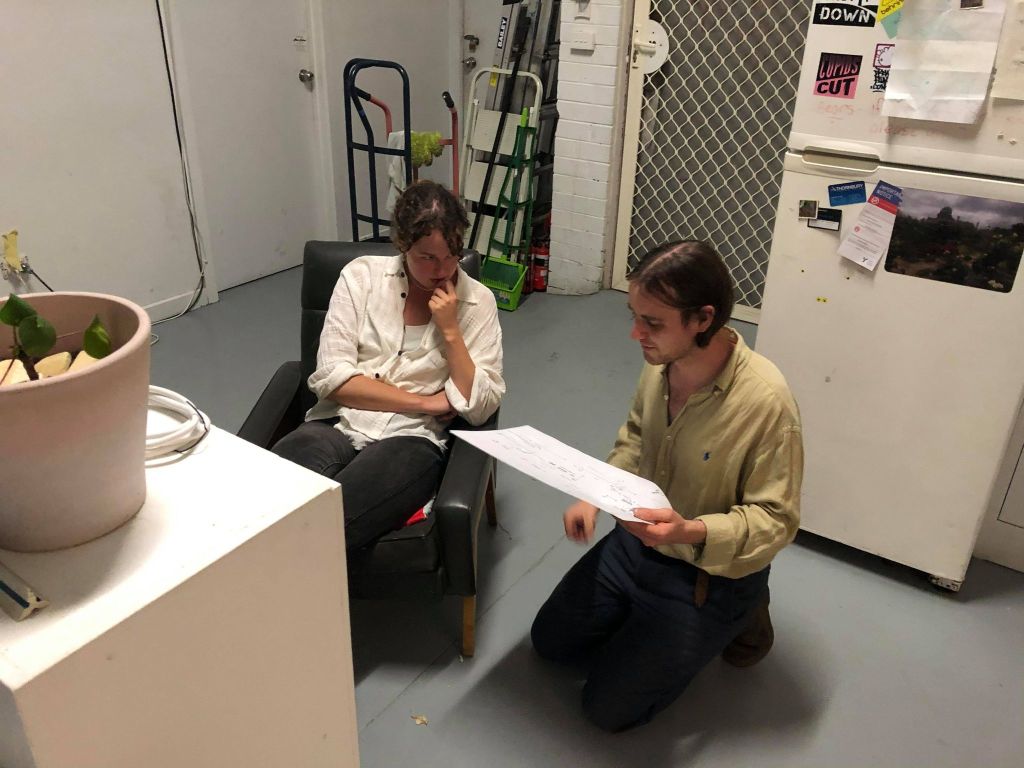
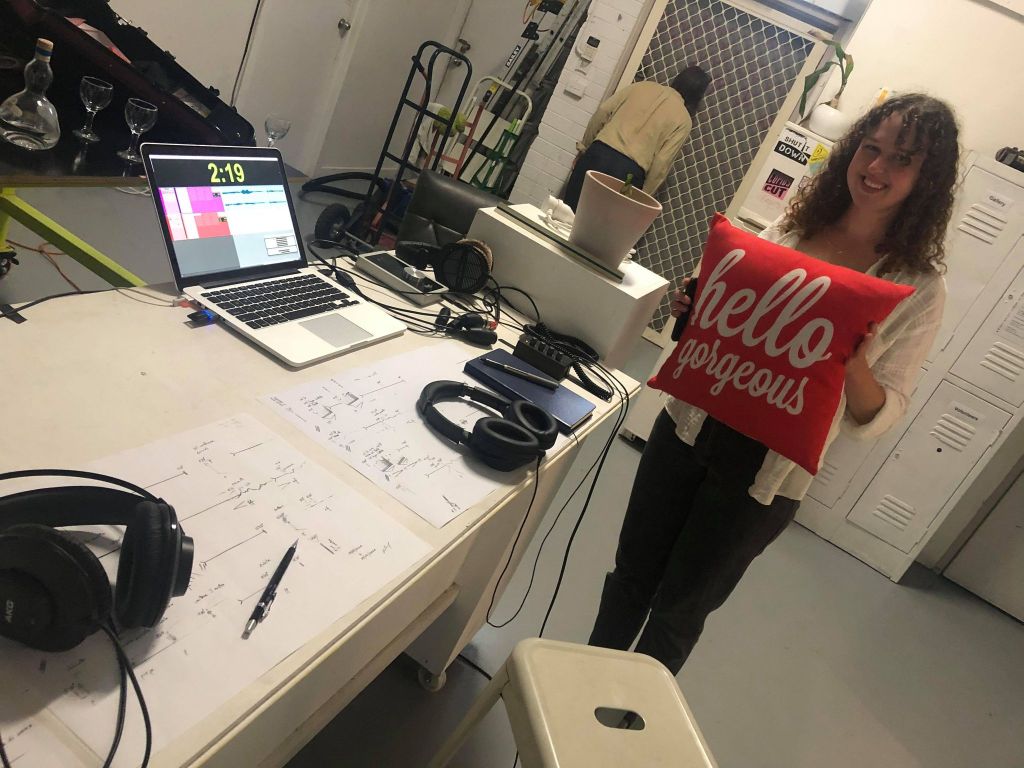
In February this year, as detailed before, the opportunity came around to write in a very short amount of time a new work for performance at a mixed-media art event. A small filtering down of this dream took place and I wrote sun study ii for Lily Tait, which though lacking the immensity and scale of the vision I had for a piece, captured a small amount of its sonic scape. We recorded the work last week in my studio. Apart from the immensely enjoyable experience with good friends of recording a work, preparing sections for second takes, etc.; it was very strange to return to a composition after an extended period of work on other musics and attempt to re-enter its world. Looking back on it, when creating the tape from the samples Lily and I recorded, I must have been processing works by the composers mentioned above (alongside, of course, the situations of recording, Lily’s performance preferences, etc.) The massiveness of rough-hewn sonorities and distances present in Xenakis early tape works, the intimate and lontano stratospheric pitches of Nono, and the sensual skies of Radulescu. Perhaps it is important to also mention that the efforts of Miles Davis and Teo Macero across many of their collaborations, inspired by Varese (and many many other names too numerable to list here) especially in say Bitches Brew are also an inspiration in the mixing and distortion of instrumental sounds to form a cohesive whole where the live/”pure” takes are merging and recoiling from edits of previous versions.
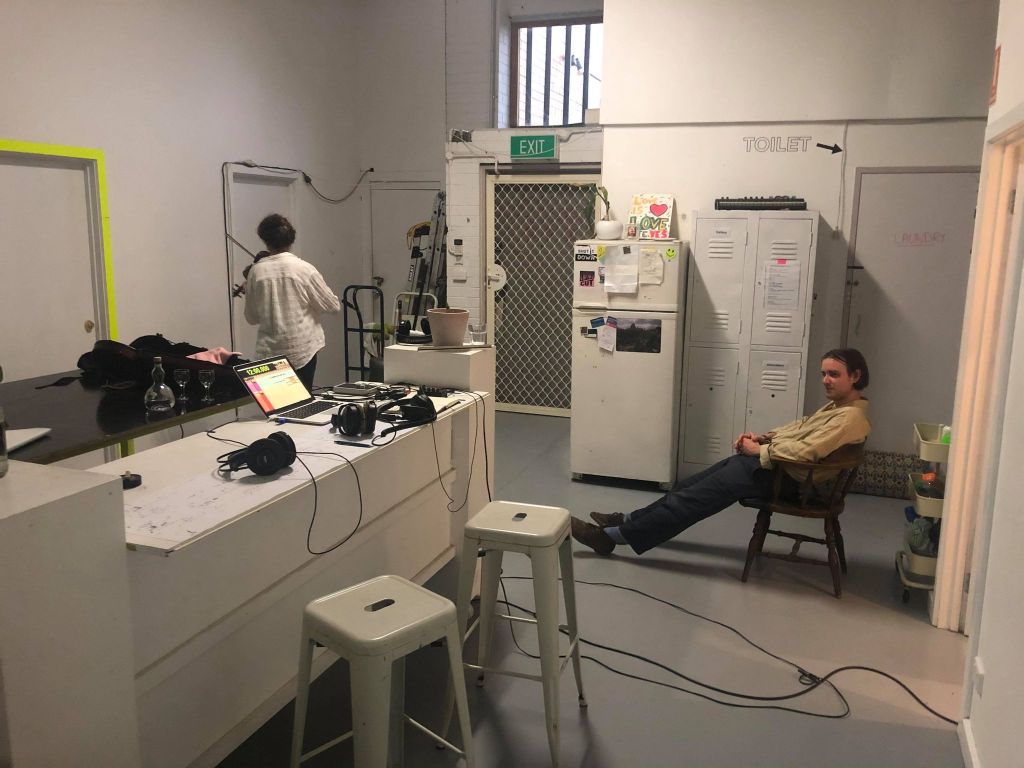
None of this is to say I believe this work responds to them specifically, or makes a fetish out of these relations; I just think looking back at your own work prompts you to go over what may have been beneath the surface of such imaginings in your head. The work we recorded is very much my own, and despite my reservations of my own heavy-handed clumsiness in its composition, it has a special quality for me in its shapes of sounds and in its relation to Lily and her special qualities as a composer and performer. The work very much was written to reflect the sounds that I believe Lily produces so well on the violin and reflect the harsh-sensuality of her playing. Recording the tape with her, more than her relation to recorded sounds she herself made, she seemed especially “in tune” with the strange emergent forms the tape took on, and little coincidences in her playing resonate for me with the tape.
What I think will be obvious to the listener, and more important the any structural or emergent-formal considerations, is the plasticity of the work. For me, this is the most important feature of any electroacoustic tape work, or indeed any introduction of or merging with electronics in composition. The fetishisation of sound sources by many sound artists or the processes applied to the sounds (from earlier pioneers like Stockhausen or Schaeffer to later works such as Boulez’s IRCAM pieces) does not interest me, these are raw materials that offer a means to explore idea-images.
(please note the score to this work is a personal document that differs greatly from my usual notation, reflecting the great trust I place in artistry of Lily and the special relationship we have – if anyone wishes to perform this work please contact me at the email below, and I would be happy to forward the score and discuss its notation, and to send a copy of the electroacoustic track. Lily has exclusive performance rights over this work in Australia until March 2021, however there is no restriction on international performances of this work.)
Recording this was special a process to me. On the day we picked the humidity slowly rose in Melbourne until the air was thick and a lushness of aspect was taken on by a city that is usually dry and shimmering in summer. Eventually, a storm broke out and as it poured onto the tin roof of the studio-warehouse where we were set up, we broke off recording and lazed while it rained. This headiness of sensation added to the closeness and precariousness of what we were recording, and to the sense of intimate occasion in the heightened sensations brought on by wet-heat.
I have to extend my huge thanks and appreciation – first to Lily Tait, who plays this piece more beautifully than it’s worth; and secondly to Nathaniel Currie, who produced the recording and sat through my kvetching as he mixed and mastered the recording for public release. This track will be on my soundcloud until we find sufficient momentum and recordings of mine, or other local and friendly composers, to make a physical release, possibly via bandcamp.
—
if you wish to discuss this work please do not hesitate to contact me at murraydavi@gmail.com
 david william murray - composer