[the below is a transcript of a video introduction programme note made for the Salamanca Arts Centre prior to the premiere of infold]
Infold
Since 2020 there has been a preoccupation in my compositional practice with works unfolding as a process of exegesis. This exegetical approach is grounded in my background in historiographical studies and literature, and is a helpful tool in not only my writing but also my approach to composition generally. To elaborate, the process itself of composition often moves away from a gnomic, barely comprehensible and certainly not legible idea or conception, to the concreting in which the former must be subjected to systematic analysis and exegesis in order for one or some aspects of itself to be brought into being. The exegetical process here reveals secrets within itself, can expound different and often simultaneous ways of looking at this idea, and can open up new directions for the idea behind the piece.
Principally, my engagement with this process is to make exterior that which is interior. The process of exegesis is in essence one of externality. When the piece is finished and performed, the performance exists as a level of externalised, outwardly looking interface between a composer and their audience. As I have grappled with this process, as well as composition as a whole, I have moved both generally (in my practice) and specifically (in relation to the conception of a piece at hand) further towards the interior space, the ‘inner landscape’. It is in this ‘inner landscape’ where the genetic ideation behind pieces may be accessed.
Infold consequently is a work for solo flute in which I have sought to have the material, the concerns of the piece, ‘in-fold’ as others might seek to ‘un-fold’. The piece, fold by fold, turns in on itself, within its sections and within its melodic arches. Infold starts forcefully, with bold impasto strokes of material pushed across its surface. Initially, its sections are short and have brut transformations. As the work progresses its sections grow and the transitions between material states and ideas become subtler, the grain of the work finer. Eventually, the sections grow so large that the material within them because stretched, weak or etiolated, and strangenesses emerge in these sections. The most radical of these strangenesses is an appearance about 2/3rds of the way through the piece that presents dislocated and new material that has repercussions for the remainder of the piece, and for me personally. The inner detail in the closing section of the piece is extremely delicate and finely wrought, contrasted with the now so grown/gigantised material that has developed onwards during the piece so that it seems blurred and indistinct, similar to the opening. As ever the elements of scaling and contrast are vital to my practice. The work concludes by folding back in on itself.
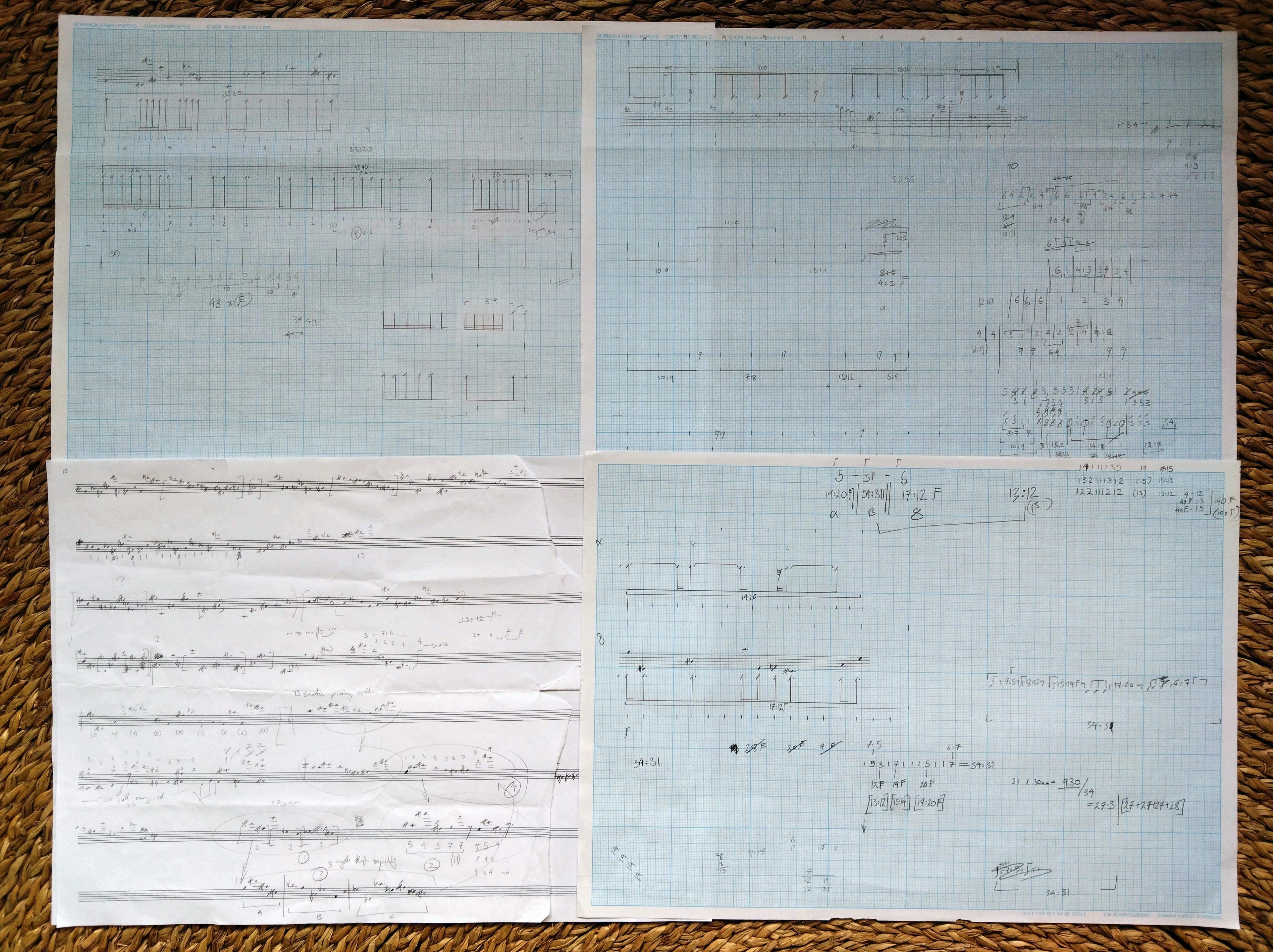
I should note that Infold is structured somewhat unusually for the player: it exists in two versions. One of these is a ‘structural’ order that sees the sections of the piece ordered according to their original structural numerology. The second is a ‘shaped’ order that sees the piece ordered by page number, and is more intuitive. Damian has opted to learn this second order. Both are important to me and present the work’s infolding in two different lights. It is my hope that one day they may be played in concert together. The two differing versions of the same piece present different routes into the interior space suggested by the piece, where the objects, situations, concerns, and sensations posited by material are in free-fall around the listener.
Infold will be premiered at Line Tracing 3 as part of the 2023 MONA FOMA Festival at the Salamanca Arts Centre, Hobart
Time & Date: 7:30pm – 25/02/2023
Performer: Damian MacDonald (flute)
I wish to acknowledge the generous support of the City of Melbourne through a Quick Response Arts Grant, without which the development of this piece would not have been possible.
 david william murray - composer